- 10/11/2026
Mozambique faces one of the highest rates of chronic malnutrition in Sub-Saharan Africa, with 37% of children under five years of age stunted and more than half of women of reproductive age suffering from anaemia. At the same time, climate shocks, food insecurity, and limited dietary diversity continue to undermine household resilience.
The approval of Mozambique’s Food and Nutrition Security Policy and Strategy (PESAN III) (2024–2030) marked a turning point. For the first time, Mozambique has a unified, multisectoral framework to align government, partners, and investments toward improving diets and reducing malnutrition.
PESAN III’s shift from a long pending draft to an approved national framework shows what coordinated action can achieve. Through focused advocacy and coalition building, CASCADE helped bring government and partners into alignment ahead of the Council of Ministers’ approval in August 2024 and now works with national and provincial authorities, particularly in Nampula, to put the strategy into practice.
This brief highlights the steps taken to secure momentum around a national strategy and to translate its priorities into localized plans, tools, and actions that advance nutrition and household resilience.
- 14/09/2026
Mozambique faces interconnected climate and nutrition challenges. Recurrent droughts, floods, cyclones, and
extreme rainfall disrupt agricultural production, livelihoods, markets, water and sanitation systems, and
health services, with important consequences for food security and nutrition. These hazards are particularly
significant because many households depend on climate sensitive agriculture for food and income. This assessment
examines how Mozambique’s national policies and institutional landscape frame the connection between
climate and nutrition .
- 16/05/2025
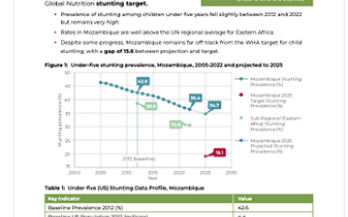
WHA Global Nutrition Stunting Target 2012-2025
Achieve a 40% reduction in the number of children under-5 who are stunted
WHA Global Nutrition Overweight Target 2012-2025
Ensure that there is no increase in childhood overweight
- 06/01/2025
NUTRITION IMPACT AT SCALE (NIS) Through the Nutrition Impact at Scale project, GAIN seeks to scale the impact of its work to increase access to safe and nutritious foods, especially for low-income consumers. By working with other organisations (Enterprise Support Organisations) that are willing and have the requisite capacity to attach a 'nutrition lens' to their work with small and medium enterprises (SMEs), Nutrition Impact at Scale (NIS) will enable a large-scale and accelerated nutrition impact for the larger African population. Funded by the Ministry of Foreign Affairs of the Netherlands, NIS uses a market systems development approach to improve food systems, increase inclusivity, and, ultimately, nutrition outcomes. The project leverages on the extensive experience GAIN have developed over the years of providing quality technical assistance, networking experience, knowledge sharing, building capacity of partners, and the provision of various tools and resources to MSMEs, to attach a 'nutrition lens' to the work of ESOs in Nigeria, Benin, Uganda, Ethiopia, Mozambique, and Kenya.
- 01/01/2025
To address the triple burden on Mozambican’s Food system, GAIN in Mozambique is focused on innovative, scalable, and impactful initiatives aimed at identifying, updating, and disseminating legislation; developing businesses that produce and distribute safe and nutritious food; and implementing approaches to increase the demand and consumption of healthier diets by all Mozambicans
- 06/11/2024
ToeffectivelytransformMozambique’snationalfoodsystemsinalignmentwiththeUnited Nations Food Systems Summit pathways, it is crucial to have access to current data and analytics. Mozambique’s Food Systems Dashboard, hosted by SETSAN1 (the National Secretariat for Food and Nutrition Security under the Ministry of Agriculture), plays a pivotal role in this transformation.
- 11/04/2023
In 2019, in an effort to improve the efficiency and sustainability of its programming, GAIN’s Workforce Nutrition Programme (WFN) shifted away from the traditional project development and evaluation cycle towards a nimbler "Quality Improvement" (QI) approach.
- 11/05/2023
The burden of malnutrition in Mozambique is marked by high rates of child stunting (38%) and micronutrient deficiencies among women of reproductive age as well as an increasing prevalence of overweight among adult men and women (18% and 34% respectively). There is a continued need to engage all actors and options to address the malnutrition burden the world faces.
- 01/12/2022
This working paper describes the application of the Behaviour Centred Design (BCD) framework to develop the 'Moments with Mothers' campaign, an intervention to improve IYCF practices supporting pregnant women, mothers, and other caregivers in Nacala Porto and Mossuril, Nampula province.
- 12/10/2022
To make sure Beira’s low-income population can continuously access affordable safe nutritious fresh foods and economic opportunities in traditional urban food markets, GAIN with funding from the government of the Netherlands supported the city of Beira by upgrading three fresh food markets.